


By Dennis Wissing, Economics Intern at the British Chambers of Commerce
The Bank of England (BoE) raised the Bank Rate to 4% on 5 November, its first increase in more than three years¹, yet gilt yields remain firmly in the headlines. Yields are below October’s peak, when 30-year yields reached 6%, a level last seen in 1998², and the 10-year yield hit its highest level since 2007³. However, they are still up considerably, with both the 5-year and 10-year yields roughly a percentage point higher than a year ago⁴.
Why have yields risen? Yields on shorter-dated gilts, such as the 2-year and 5-year, reflect what investors expect Bank Rate to be over that period, so their rise suggests investors expect further rate rises. This is driven by higher inflation expectations due to the oil and energy shocks of the Iran war. Yields on longer-dated gilts, such as the 10-year, also reflect expectations for growth and debt sustainability. But what effect do these increases actually have on businesses, and how much should SMEs worry?
The financing channel
Gilt yields are a benchmark for borrowing costs, so when they rise, borrowing becomes more expensive for businesses⁵. Take a small housebuilder with a £300,000 fixed-rate loan coming up for refinancing. BoE data shows the average rate on new fixed-rate SME loans rose from around 3.4% in December 2021 to around 7.8% in September 2026⁶. If the housebuilder refinanced the same £300,000 balance at those rates, its annual interest cost would more than double. This is because gilt yields are the interest rate the government pays to borrow, and as the UK is very unlikely to default, gilts are seen as a “risk-free” investment. Lenders use this rate as a starting point and add a margin to cover their own costs, the risk of the borrower not repaying, and their profit. This means that when gilt yields rise, this underlying benchmark rises and the housebuilder’s loan becomes more expensive.
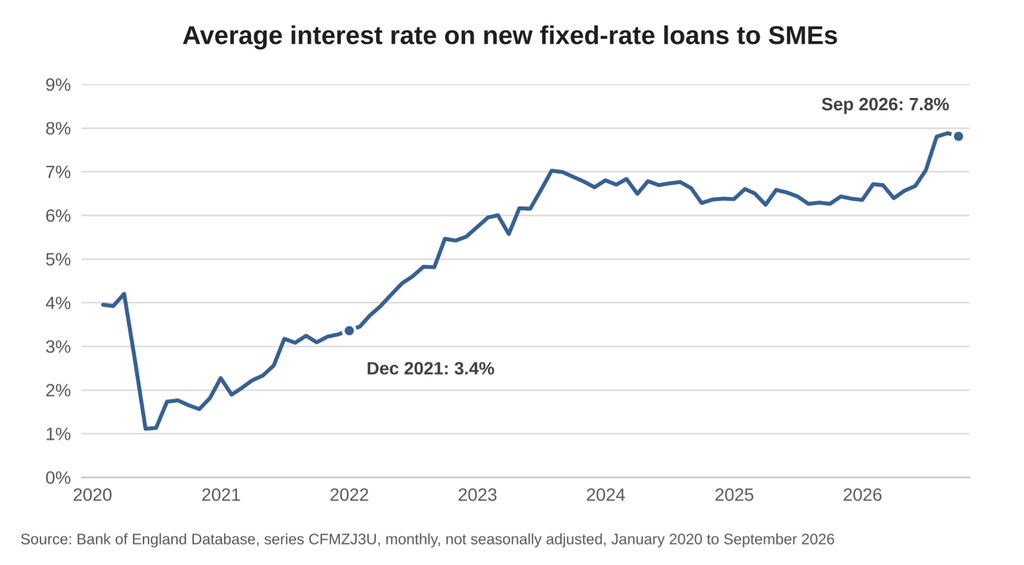
This affects fixed-rate loans, such as commercial mortgages, asset finance and term loans, which are priced against gilt yields of a similar length to the loan. For example, a 2-year fixed-rate asset finance loan is priced against 2-year gilt yields, while a 5-year commercial mortgage is priced against 5-year gilt yields. As these loans become more expensive, businesses re-evaluate future investment and hiring decisions. The latest BCC Quarterly Economic Survey shows that only 17% of UK firms plan to increase investment, with 25% citing borrowing costs as a concern, although inflation remains the top concern for businesses, cited by 60%⁷.
The indirect effects
Furthermore, higher gilt yields indirectly affect SMEs by weighing on consumer demand. When gilt yields increase, they push up not only SME loan rates but also the rates retail banks charge on consumer fixed-rate loans⁸. This affects households around the country, who see their mortgage costs rise. Some hold off on buying, as seen in the decrease in housing demand, while others need to refinance and face the higher cost. BoE data shows the average quoted rate on a 2-year fixed mortgage rose by 1.2 percentage points year on year⁹. This limits consumers’ disposable income⁸, which in turn hurts consumer discretionary SMEs. Take the housebuilder, for example. Not only do its own borrowing costs rise as it refinances, but higher mortgage rates make potential buyers less willing to purchase, hitting margins from both ends.
Put simply, SMEs will face both direct and indirect pressure, with gilt yields making borrowing more expensive while weakening consumer demand. On the borrowing side, SMEs are particularly exposed because they rely more heavily on bank loans and have less access to alternative sources of finance than larger corporations¹⁰. While the effects may not be immediate, businesses will feel the cost if yields remain high, as they will eventually need to refinance.
UK vs the G7
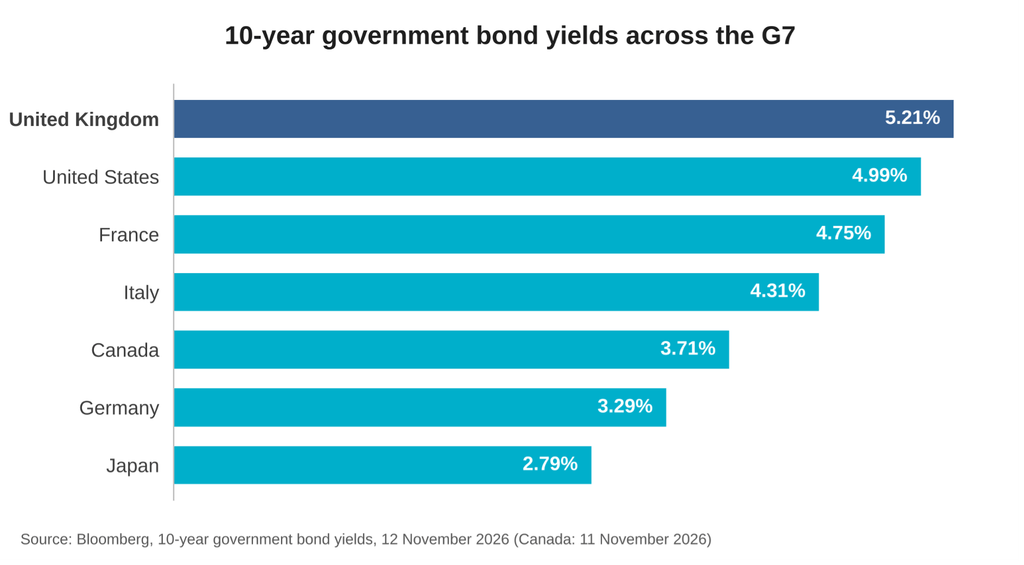
Compared with the other G7 economies, the UK stands out. Its 10-year gilt yield is the highest, almost 2 percentage points above Germany’s¹¹. Part of the reason, according to NIESR, is that UK inflation reacts more strongly to oil shocks than inflation in other advanced economies¹². This sticky inflation has been accompanied by continued political instability, with six prime ministers taking office since 2016¹³. This combination has weakened investor confidence in gilts, so investors demand higher returns on them than on other major European government bonds¹⁴.
What will happen next?
Predicting future gilt yields is difficult. However, yields at these levels are not unprecedented. Before the 2007–08 financial crisis, gilt yields were around the 5% mark¹⁵, although UK debt-to-GDP was around a third of its current level¹⁶. Inflation also continues to put pressure on gilt yields: the BoE forecasts it to rise to around 5% by mid-2027 and has warned that at least one more rate rise is likely if the US-Iran conflict continues¹. An end to the conflict would help reassure investors going into winter.
At the longer end, the BoE’s decision to pause gilt sales until April and stop selling long-dated gilts entirely has eased some of the pressure¹⁷. However, fiscal and term-premium issues persist and weigh heavily on investor sentiment¹⁸. With the BoE not expecting inflation to return to its 2% target until Q3 2028¹, SMEs could face elevated costs on fixed-rate loans going into 2027 and beyond.
Sources
- Bank of England, “Bank Rate increased to 4%, November 2026 Monetary Policy Summary and minutes,” and Monetary Policy Report, November 2026, 5 November 2026. https://www.bankofengland.co.uk/monetary-policy-summary-and-minutes/2026/november-2026; https://www.bankofengland.co.uk/monetary-policy-report/2026/november-2026. Reuters, “Bank of England raises rates for first time since 2023, says more may come,” 5 November 2026 (via The Express Tribune). https://tribune.com.pk/story/2638826/bank-of-england-raises-rates-for-first-time-since-2023-says-more-may-come
- MarketScreener, “UK 30-year gilt yields top 6% for the first time since 1998.” https://www.marketscreener.com/news/uk-30-year-gilt-yields-top-6-for-the-first-time-since-1998-ce785ad3df8af323
- Trading Economics, “UK 10Y Bond Yield Hits 19-year High,” 8 October 2026. https://tradingeconomics.com/united-kingdom/government-bond-yield/news/590828
- Bloomberg, “United Kingdom Rates & Bonds,” 11 November 2026: 5-year 4.92%, 10-year 5.22%. https://www.bloomberg.com/markets/rates-bonds/government-bonds/uk. MNI, “EGBs-Gilts Cash Close: Gilts Easily Outperform On Soft Labour Data,” 11 November 2025: 5-year 3.857%, 10-year 4.387%. https://www.mnimarkets.com/articles/egbs-gilts-cash-close-gilts-easily-outperform-on-soft-labour-data-1762890075957
- HSBC UK, “Markets Explained: Why gilt yields matter for your money,” 11 August 2026. https://www.hsbc.co.uk/wealth/insights/learn-to-invest/start-investing/markets-explained-why-gilt-yields-matter-for-your-money/
- Bank of England Database, series CFMZJ3U: monthly average interest rate on new fixed-rate advances to SMEs. https://www.bankofengland.co.uk/boeapps/database/fromshowcolumns.asp?Travel=NIxSUx&FromSeries=1&ToSeries=50&DAT=RNG&FD=1&FM=Jan&FY=2020&TD=11&TM=Oct&TY=2026&FNY=&CSVF=TT&html.x=123&html.y=46&C=RBD&Filter=N
- British Chambers of Commerce, Quarterly Economic Survey Q3 2026, “Turnover Confidence Improves But Investment Still Struggling,” 13 October 2026. https://www.britishchambers.org.uk/news/2026/10/turnover-confidence-improves-but-investment-still-struggling/
- Bank of England, Monetary Policy Report, May 2023, Box B, “The cash-flow channel of monetary policy.” https://www.bankofengland.co.uk/monetary-policy-report/2023/may-2023
- Bank of England Database, series IUMBV34: monthly interest rate of UK monetary financial institutions (excl. Central Bank) sterling 2 year (75% LTV) fixed rate mortgage to households, not seasonally adjusted. https://www.bankofengland.co.uk/boeapps/database/fromshowcolumns.asp?Travel=NIxSTxTIxSUx&FromSeries=1&ToSeries=50&DAT=RNG&FD=1&FM=Jan&FY=2016&TD=11&TM=Nov&TY=2026&FNY=&CSVF=TT&html.x=161&html.y=39&C=EOT&C=RO&Filter=N
- Bank of England, Financial Stability Report, July 2025, Section 4, “In focus – Contributing to sustainable growth,” Box B. https://www.bankofengland.co.uk/financial-stability-report/2025/july-2025
- Bloomberg, 10-year government bond yields, 12 November 2026: UK 5.21%, Germany 3.29%. https://www.bloomberg.com/markets/rates-bonds/government-bonds/uk; https://www.bloomberg.com/markets/rates-bonds/government-bonds/germany
- NIESR, “How Will The Energy Shock Hit The UK Economy?”, 2 April 2026. https://niesr.ac.uk/blog/how-will-energy-shock-hit-uk-economy
- GOV.UK, “Past Prime Ministers.” https://www.gov.uk/government/history/past-prime-ministers. GOV.UK, “Prime Minister.” https://www.gov.uk/government/ministers/prime-minister
- Centre for Macroeconomics and NIESR, “May 2026 CfM-NIESR survey: gilt yields, fiscal and political uncertainty,” 28 May 2026. https://niesr.ac.uk/news/may-2026-cfm-niesr-survey-gilt-yields-fiscal-and-political-uncertainty
- Bank of England, historical yield-curve data. https://www.bankofengland.co.uk/statistics/yield-curves
- House of Commons Library, “What are government debt and debt interest?” https://commonslibrary.parliament.uk/research-briefings/cbp-10842/. Office for National Statistics, “Public sector finances, UK: September 2026,” 21 October 2026. https://www.ons.gov.uk/economy/governmentpublicsectorandtaxes/publicsectorfinance/bulletins/publicsectorfinances/september2026
- Bank of England, “Monetary Policy Summary and minutes, September 2026,” 17 September 2026. https://www.bankofengland.co.uk/monetary-policy-summary-and-minutes/2026/september-2026. Reuters, “Investors cheer BoE move to pause gilt sales, driving bond rally,” 17 September 2026 (via Global Banking & Finance Review). https://www.globalbankingandfinance.com/investors-cheer-boe-move-pause-gilt-sales-driving-bond-rally/
- Goldman Sachs, “Why global bond yields are surging.” https://www.goldmansachs.com/insights/goldman-sachs-exchanges/why-global-bond-yields-are-surging