WE’RE calling on the
CHANCELLOR TO use his first budget to CUT THE COST
OF DOING BUSINESS
The Government wants good growth in every postcode. That will only happen if businesses feel confident to invest, recruit and trade.
Right now, that confidence is being crushed by ever-increasing costs.
why this matters
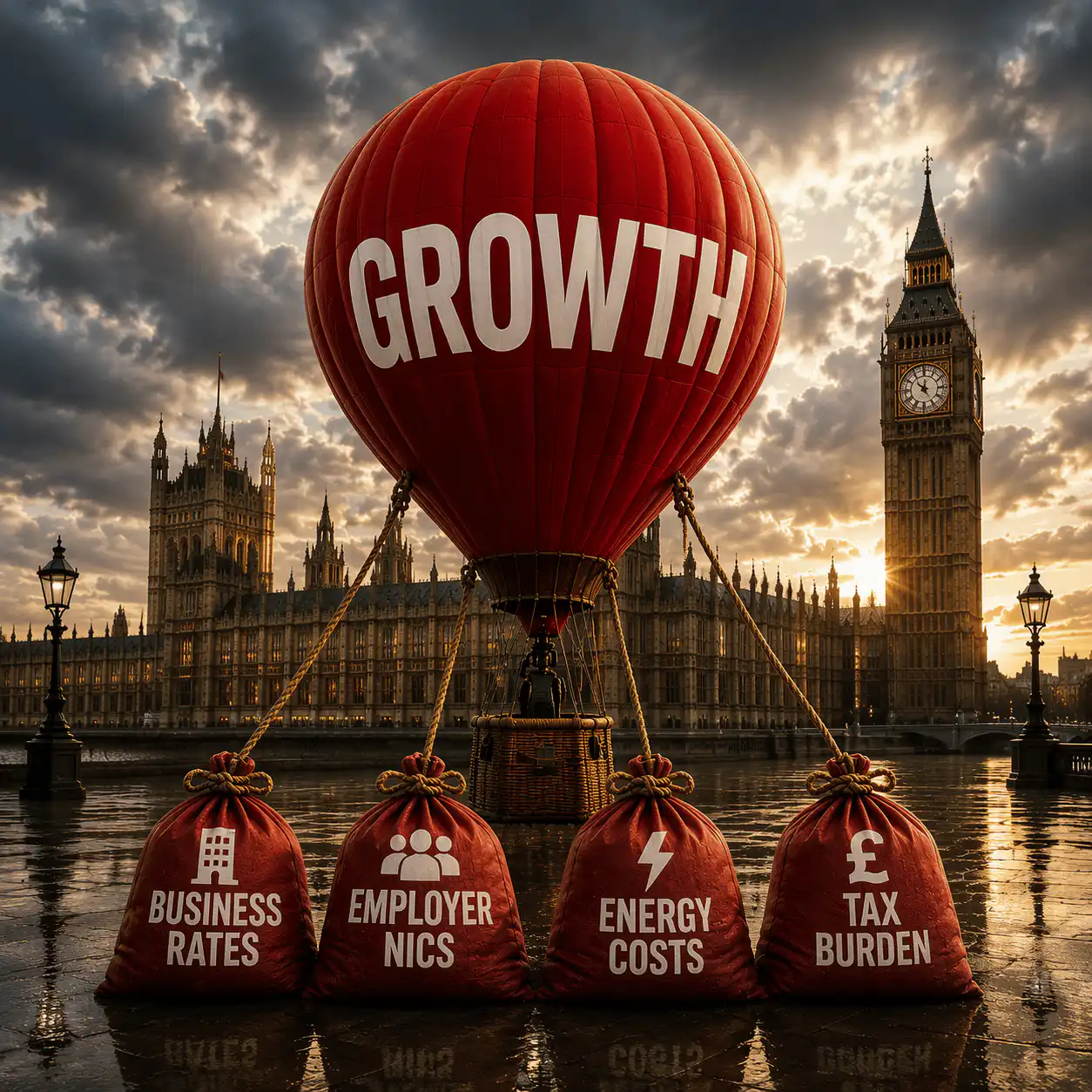
Britain cannot achieve stronger economic growth while Government-driven costs for businesses keep rising.
At the Budget, we urge the Chancellor to back business by cutting these costs, boosting confidence, and creating the right conditions for firms to invest, hire and grow.
Britain is becoming too expensive for business. You cannot grow an economy by making it less competitive.
High costs are choking business confidence. As costs keep rising, confidence is falling and growth stalling.
Lower costs. Higher growth. The best way to unlock growth in every postcode is to reduce the cost of doing business.
"Our Budget test is simple: Will it reduce costs for business and increase confidence? If it does, we will support it. If it doesn't the economy will falter."
at the budget, the chancellor has the opportunity to:
A COST OF DOING BUSINESS CRISIS
A typical mid-sized firm (50 staff, £5m turnover) now pays around £1.98m a year in domestic policy-driven costs, up from £1.16m in 2016. An overall increase of £827,000.
Successive Governments have made policy decisions which have added to these business costs. These include increases to Employer NICS, successive National Living Wage rises, business rates changes and new compliance obligations (e.g. Making Tax Digital).
The problem is structural. We have seen a permanent step-change in the cost of doing business. After adjusting for inflation, the cost stack has risen from around 32% to 40% of a typical firm's revenue.
The 2024 changes to employer National Insurance were a seismic moment and hit business confidence hard. They accounted for a quarter of the entire decade’s increase. We are yet to see a meaningful recovery.
Costs dominate business concerns. Labour costs are the number-one price pressure for 70% of firms. Investment intentions are now at their lowest level since the pandemic.
Try our cost stack calculator
Use the Cost Stack Calculator to see how rising UK policy costs have affected your business and help build the evidence for change.
“As a business owner, we are being taxed out of existence.”
Micro services firm in Yorkshire and The Humber
try our cost stack calculator
Since 2016, domestic policy-driven costs have added significant pressure to UK businesses. Our modelling shows that for a typical SME, these costs have risen by more than 70%, with around a quarter of that increase coming since the Autumn 2024 Budget.
Use the calculator to see how your business compares and submit your figures anonymously to help demonstrate the true scale of cost pressures facing British businesses.
The message from business is clear. If the Government wants to see good growth in every postcode, then this needs to be a Budget that cuts, not adds, to the cost of doing business.
The BCC has published its budget submission to HM Treasury which makes this call clear.
In our letter to the Chancellor, John Healey, we set out the top three fiscally responsible measures the government can take to ease business costs and support growth. We also proposed a series of medium to long-term measures that should inform the government’s upcoming 10-year plan.
The BCC’s proposals address identifiable constraints on growth, draw on evidence from business and focus on areas where modest public investment can unlock wider economic returns.
making the case to lower the cost of doing business
Fireside chat with the Rt Hon Jonathan Reynolds MP
Shevaun Haviland CBE sits down with the Rt Hon Jonathan Reynolds MP for a wide-ranging fireside chat on the key issues shaping the UK business environment ahead of the Autumn Budget 2026.
back business to deliver growth
Shevaun Haviland CBE, Director General of the British Chambers of Commerce speech at the BCC Global Annual Conference.
UK must tap dormant wealth to drive growth
Andy Haldane’s CBE, President of the British Chambers of Commerce, speech at the BCC’s Global Annual Conference.
Investment depends on the right fiscal and regulatory conditions, including tax, planning, energy costs, connectivity, finance access, and growth incentives.